 By dylan
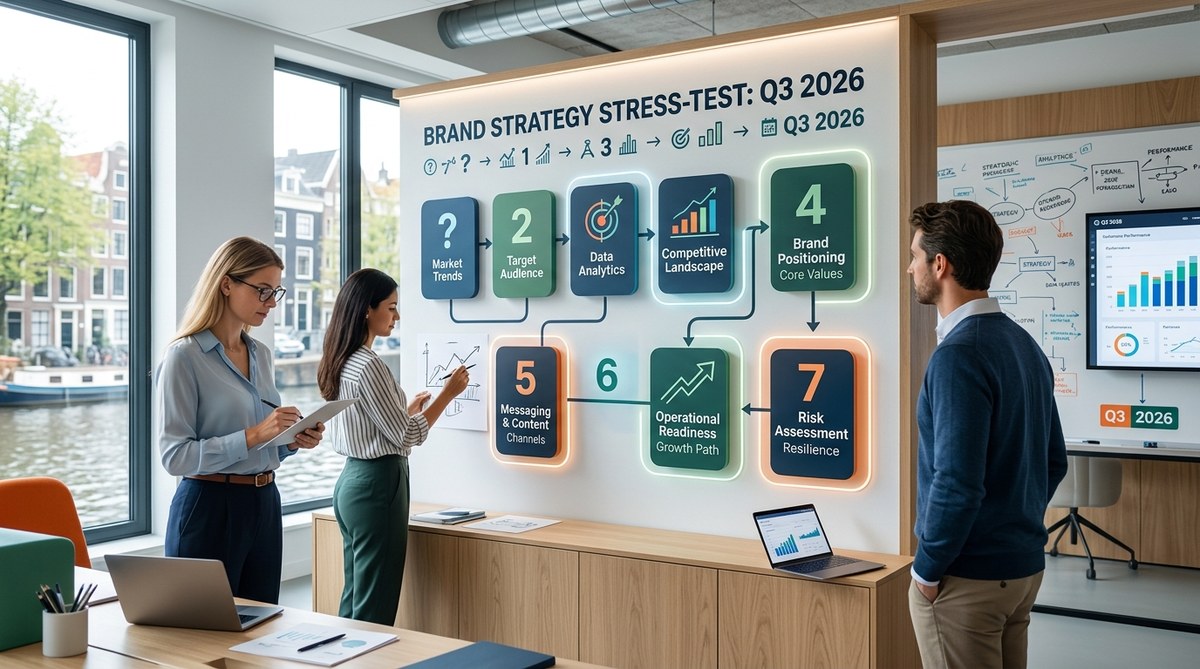
You are sitting in a quarterly review meeting. The coffee is cold. The slides are dense. And someone just asked, “But does our brand actually stand for something?” That question hung in the air because no one had a simple answer. If that scene feels familiar, you are not alone. Many brand strategies look great on paper but crumble under real pressure. The good news? You can fix that before Q3 begins. You just need the right brand strategy questions to stress-test your plan.
A strong brand strategy can survive seven tough questions about clarity, consistency, differentiation, and audience fit. Use this framework to find weak spots before they become expensive problems. Each question acts as a diagnostic tool for marketing directors and brand strategists planning their next fiscal year.
Why stress-test your brand strategy now?
Mid-size and large companies often build brand strategies during Q4 planning. But waiting until December to find a flaw is risky. By Q3, you have enough data to see what is working and what is not. You also have enough time to adjust before the next budget cycle locks in.
Stress-testing is not about tearing your work apart. It is about finding the one weak leg that could collapse under pressure. Think of it like checking the tires on your car before a long road trip. You do not want to discover a slow leak at 70 miles per hour on I-95.
The 7 brand strategy questions that reveal the truth
These brand strategy questions are designed to be asked in order. Each one builds on the last. You can run through them alone or with your team in a two-hour workshop.
1. Does your brand purpose pass the “so what” test?
Many brands have a purpose statement. Few have one that actually changes how they operate. Ask yourself: if your purpose disappeared tomorrow, would anyone notice?
Take a look at your last three marketing campaigns. Did they connect back to your purpose? Or did they just promote features? A purpose that does not influence creative decisions is just a poster on the wall.
“A brand purpose is not a slogan. It is a constraint that guides every decision. If your team cannot use it to say no to a good opportunity, it is not a real purpose.” – Anonymous brand strategist at a Fortune 500 company
2. Can your top three leaders describe your brand positioning in one sentence?
This is the most practical of all brand strategy questions. Walk into the CEO’s office. Ask them to describe your brand positioning without looking at a document. Then ask the CMO. Then the head of product.
If their answers do not match, you have a consistency problem. Your brand cannot be one thing to the CEO and another thing to the product team. Customers feel that friction.
3. What is the one thing your brand does better than anyone else?
This question should be uncomfortable. If you struggle to answer, your differentiation is weak. Most brands try to be good at many things. The strongest brands are exceptional at one.
| Common mistake | Better approach |
|---|---|
| Claiming to be “the most innovative” | Naming the specific innovation you own |
| Saying “we put customers first” | Showing a policy that proves it |
| Calling yourself “premium” | Defining what premium means in your category |
| Using “quality” as a differentiator | Explaining how your quality is unique |
If you want to go deeper on this topic, check out our guide on mastering brand differentiation in a crowded digital space.
4. Who is your brand specifically not for?
This is one of the hardest brand strategy questions because it feels counterintuitive. You want to grow. You want to reach everyone. But brands that try to appeal to everyone end up appealing to no one.
List the customer segments you will intentionally not serve. Write them down. If you cannot name three groups, your targeting is too broad. A strong brand makes enemies. Not real enemies, but clear choices about who is not the right fit.
5. Does your visual identity match your verbal identity?
A brand is a promise. That promise is delivered through visuals and words. If your website looks modern but your copy sounds like a legal document, there is a crack in the foundation.
Audit your last five touchpoints. That includes your website, a social media post, a customer email, a product page, and an ad. Do they feel like they come from the same brand? If the answer is no, prioritize alignment before Q3.
6. What would your biggest competitor say about your brand?
Imagine your top competitor is giving a presentation to their board. They are explaining why customers choose them over you. What do they say?
Be honest. If they would say “we have better customer service” or “our product is easier to use,” those are real weaknesses you need to address. This question reveals blind spots that internal teams often miss.
7. If your brand disappeared from the market, who would actually miss you?
This is the ultimate stress test. It separates essential brands from optional ones. If only your employees would miss your brand, you have a problem. If customers would feel a real loss, you have built something valuable.
To strengthen your answer, read our post on how to build a brand purpose that drives genuine customer connections in 2026.
A practical process for running the stress test
You do not need a fancy workshop or an expensive consultant. Follow this simple process with your team.
- Schedule a three-hour block. No phones. No laptops except for note-taking. Go to a conference room or a neutral space.
- Assign a facilitator. This person keeps the conversation moving and prevents rabbit holes.
- Answer each question in order. Spend 20 minutes per question. Write down the honest answer, not the polished one.
- Identify your weakest area. At the end, vote on which question exposed the biggest gap.
- Create a 90-day action plan. Focus on fixing that one gap before Q3 ends. Do not try to fix everything at once.
Common mistakes when stress-testing your brand
Even experienced marketing directors fall into these traps. Watch out for them.
- Defensiveness. When someone challenges your brand, it is easy to get defensive. Stay open. The goal is improvement, not protection.
- Groupthink. If everyone agrees too quickly, you are not pushing hard enough. Encourage dissent.
- Vague answers. “We are customer-focused” is not an answer. Push for specifics.
- Skipping the hard questions. Question four and seven are the most uncomfortable. Do not rush through them.
For more on avoiding these pitfalls, read our guide on 7 brand strategy frameworks for navigating economic uncertainty in 2026.
What to do with your stress test results
Once you have your results, prioritize ruthlessly. You cannot fix everything in one quarter. Pick the one area that would cause the most damage if left unaddressed. Then build a plan.
Here is a simple way to prioritize:
- If your purpose is weak, start there. Everything else flows from purpose.
- If your positioning is unclear, fix messaging first. Visuals can wait.
- If your differentiation is fuzzy, invest in product or service improvements before marketing.
- If your audience targeting is too broad, narrow your focus. You can always expand later.
The tools you need to execute
You do not need a massive tech stack to run this stress test. But a few tools can help.
- A shared document for capturing answers and notes
- A timer to keep each question to 20 minutes
- A simple voting tool (sticky notes work fine) to identify the weakest area
- Access to customer feedback or survey data to validate your answers
If you want to use data to strengthen your position, our post on harnessing consumer insights to transform your brand positioning will help.
When to run the stress test again
Brand strategy is not a one-time exercise. Markets shift. Audiences change. Competitors evolve. Plan to run this stress test twice a year. Once before Q3 to catch mid-year drift. Once before Q1 to set the foundation for the new year.
If your industry moves fast, consider a lighter version every quarter. Pick three of the seven brand strategy questions and spend one hour on them. That keeps your strategy fresh without burning out your team.
Your brand strategy is only as strong as your next question
The best marketing directors and brand strategists do not have all the answers. They have the right questions. These seven brand strategy questions are not meant to make you feel bad about your current work. They are meant to make your next quarter stronger.
So block off that three-hour slot. Gather your team. Ask the hard questions. And use what you learn to build a brand that can handle whatever 2026 throws at you.
If you want to keep the momentum going, check out our guide on how to craft a future-proof brand strategy in 2026. It pairs perfectly with the stress test results.