 By dylan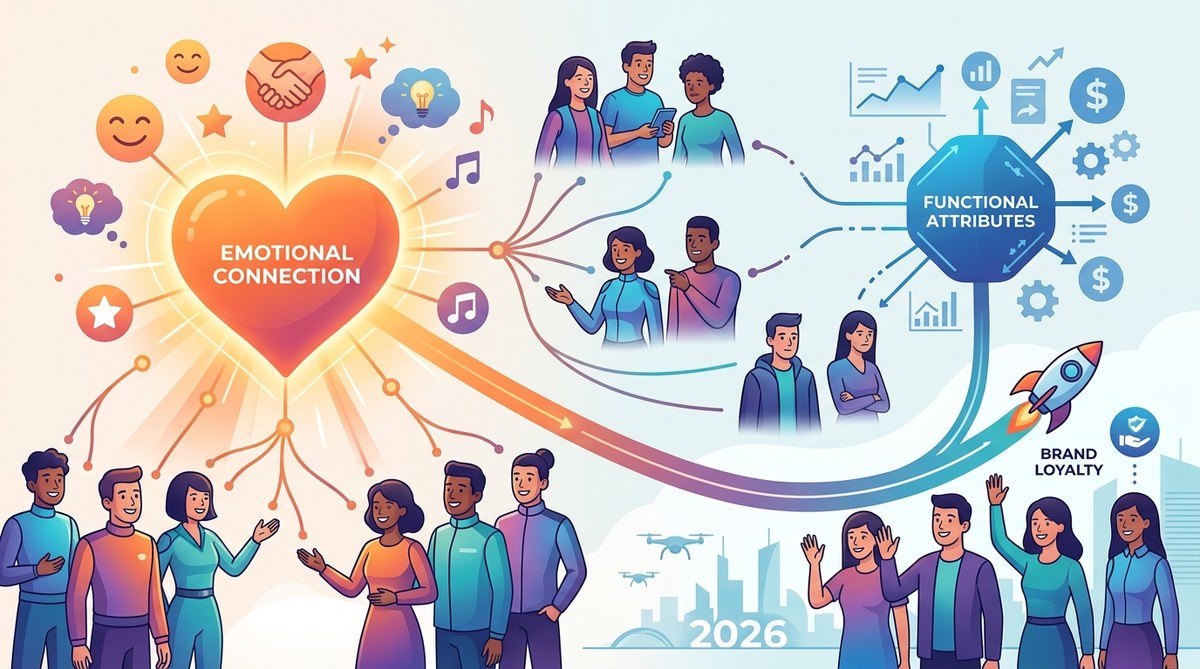
Most brands in 2026 sound the same. They promise speed, quality, and innovation. They list features. They show specs. And consumers scroll past them without a second thought. The problem is not that these brands lack value. The problem is that they fail to make people feel something. Emotional branding is not a soft, fluffy concept reserved for luxury labels or nonprofits. It is a measurable, data-backed strategy that drives loyalty, increases customer lifetime value, and gives you a competitive edge that competitors cannot copy. Yet most marketing teams treat it as an afterthought. Here is why that is a mistake and how you can fix it starting today.
Emotional branding in 2026 is not about making people cry in an ad. It is about consistently triggering specific feelings that align with your brand promise at every touchpoint. Brands that master this see up to 3x higher retention rates and significantly lower price sensitivity. This guide walks you through the science, the strategy, and the execution steps to make emotion your most powerful, underused asset.
The Science Behind Why Emotion Drives Purchase Decisions
Neuroscience has confirmed what great marketers always suspected: people buy on emotion and justify with logic. When a consumer chooses one brand over another, the decision happens in milliseconds. The rational brain does not get a vote until later.
Functional magnetic resonance imaging (fMRI) studies show that strong emotional responses activate the brain’s reward centers more than rational appeals do. A 2025 study from the Journal of Consumer Psychology found that emotional ads were 23% more effective at driving purchase intent than purely informational ads. That gap is widening in 2026 as consumers face more choices than ever.
Think about the last time you chose a brand of sneakers. Did you pick the one with the best rubber compound data? Or did you pick the one that made you feel like an athlete, an adventurer, or part of a community? The feeling came first.
This is why an emotional branding strategy for 2026 must move beyond surface level tactics. You cannot just slap a heartwarming story on your About page and call it a day. You need to engineer emotional triggers into every part of the customer journey.
Why Most Brands Get Emotional Branding Wrong
Most marketing managers assume they are already doing emotional branding. They run a campaign with a smiling family. They post a video about their company values. They sponsor a charity event. These actions are not emotional branding. They are emotional decoration.
Real emotional branding changes how a customer feels about themselves when they interact with your brand. It is not about you. It is about the identity your product gives them.
Here are the three most common mistakes brands make:
| Mistake | What It Looks Like | The Fix |
|---|---|---|
| Generic positivity | Using happy stock photos and vague feel-good language | Identify a specific emotion tied to your product benefit (confidence, relief, belonging) |
| Inconsistent tone | Warm in ads, cold in customer service | Map emotional touchpoints across the entire funnel |
| Fear of negative emotions | Avoiding any feeling that is not pure joy | Embrace emotions like frustration relief, nostalgia, or even righteous anger |
A brand that only aims for “happy” is a brand that nobody remembers. The most powerful emotional branding strategies in 2026 are specific, nuanced, and sometimes uncomfortable.
How to Build an Emotional Branding Strategy for 2026
Building an emotional brand is a process. It requires research, intention, and a willingness to be specific. Follow these steps to create a strategy that actually works.
-
Identify your core emotional territory. Not every emotion fits every brand. A tax software brand should not aim for excitement. It should aim for relief, control, and peace of mind. A outdoor gear brand should aim for awe, confidence, and freedom. Pick one primary emotion and two secondary emotions that match your brand promise.
-
Map emotional moments across the customer journey. Where does a customer feel anxious? Where do they feel proud? Where do they feel confused? These are your opportunities. For example, the moment after a customer completes a purchase is often filled with doubt. A brand that sends a reassuring, celebratory message at that moment creates an emotional bond.
-
Design signals that trigger those emotions. Colors, words, sounds, textures, and interactions all carry emotional weight. A warm orange button says something different than a cold blue one. A handwritten font says something different than a sans serif. Audit every element of your brand identity for emotional consistency.
-
Train your team to deliver the emotion. Your customer support reps, your social media managers, and your packaging team all need to understand the emotional goal. If your brand promises confidence, your support team should not sound apologetic. They should sound empowering.
-
Measure emotional response, not just clicks. Use sentiment analysis, open ended survey questions, and Net Promoter Score follow ups that ask “how did this make you feel?” Track emotional metrics alongside traditional KPIs.
Real World Examples of Emotional Branding Done Right
Some brands have already mastered this approach. They are not the obvious ones. Here are three examples that show different emotional territories.
Dove has owned the emotion of self acceptance for over a decade. In 2026, they continue to evolve this by focusing on real beauty standards in AI generated imagery. Their campaigns do not just talk about feeling good. They challenge the systems that make women feel bad. That is a specific, powerful emotional stance.
Patagonia uses the emotion of righteous anger mixed with hope. They do not shy away from making customers feel uncomfortable about consumption. Their “Don’t Buy This Jacket” campaign from years ago still influences their 2026 strategy. They make customers feel like activists, not just shoppers.
Headspace owns the emotion of calm competence. In a world of anxiety, they offer not escape but clarity. Their branding makes users feel capable of handling stress, not just avoiding it. That is a subtle but crucial difference.
Each of these brands picked one emotional lane and stayed there. They did not try to be everything to everyone.
The Role of AI and Personalization in Emotional Branding
Many marketers worry that AI will make branding more robotic. The opposite is true. AI in 2026 allows brands to deliver emotional experiences at scale, but only if the emotional framework is already in place.
Imagine a clothing brand that knows its emotional territory is confidence. AI can help personalize the shopping experience by showing a customer the exact outfit that makes them feel powerful on a day they need a boost. The AI does not create the emotion. It amplifies the right emotional signal at the right moment.
The danger is using AI to optimize for efficiency instead of emotion. An AI that optimizes for click through rates will often choose the most generic, safe option. That is the enemy of emotional branding. You need to train your AI on emotional outcomes, not just conversion metrics.
For more on how to blend data with creativity, read our guide on
Common Emotional Branding Pitfalls to Avoid in 2026
Even well intentioned brands fall into traps. Here is a bulleted list of pitfalls to watch for:
- Emotional tourism. Borrowing emotions from cultures or communities you do not belong to. This backfires instantly in 2026.
- Overpromising. Telling customers you will make them feel amazing, then delivering a mediocre product. Emotion must be backed by experience.
- Inconsistency across channels. Being warm on Instagram and cold on the phone. Customers notice the gap.
- Ignoring negative emotions. Pretending every interaction must be positive. Sometimes a customer needs to vent. Let them.
- Copying competitors. If your competitor owns “adventure,” do not try to out adventure them. Find your own emotional lane.
“The most successful brands in 2026 will be the ones that make their customers feel understood, not just served. Understanding requires empathy. Empathy requires listening. Most brands are terrible at listening.” – Sarah Chen, Brand Strategy Director at JWT Amsterdam
A Practical Framework for Testing Emotional Branding
You do not need to overhaul your entire brand overnight. Start with one touchpoint and test.
Choose one customer interaction point. It could be your onboarding email sequence, your checkout page, or your customer service phone script. Identify the current emotional state of the customer at that point. Then design a change that shifts that emotion toward your target feeling.
Run an A/B test. Measure not just conversion rates but also qualitative feedback. Ask a small group of customers “how did this make you feel?” Compare the results.
Scale what works. Add one more touchpoint. Repeat.
This iterative approach reduces risk and builds internal buy in. Your team will see the data before they commit to a full rebrand.
Why Emotional Branding Is the Most Underused Strategy in 2026
The reason is simple. Emotional branding is harder to measure than performance marketing. It requires patience. It requires creativity that cannot be automated away. Most marketing teams are rewarded for short term metrics like cost per acquisition and click through rate. Emotional branding pays off in retention, lifetime value, and word of mouth. Those metrics take longer to show up.
But the brands that invest in emotional connection now will own the market in three years. When every competitor can copy your product features, your pricing, and your shipping speed, the only thing they cannot copy is how you make people feel.
That is your moat. That is your unfair advantage.
Your Emotional Branding Action Plan for the Next 30 Days
Here is a simple plan to get started:
- Week 1: Audit your current brand touchpoints. List every place a customer interacts with your brand. Rate each one on how it makes a customer feel.
- Week 2: Conduct five customer interviews. Ask them to describe your brand in three emotions. Listen for the gap between what you want to convey and what they feel.
- Week 3: Pick one emotion to own. Write a one page brief that defines that emotion in specific, behavioral terms.
- Week 4: Redesign one touchpoint to deliver that emotion. Launch it. Measure the response.
You do not need a massive budget. You need intention and consistency.
Building an Emotional Brand That Lasts
Emotional branding is not a campaign. It is not a slogan. It is a long term commitment to making your customers feel a specific way every time they encounter your brand. In 2026, when attention spans are shorter than ever and competition is fiercer than ever, the brands that win will be the ones that make people feel something real.
Start small. Stay specific. Measure what matters. And remember that the goal is not to make customers love your brand. The goal is to make them love who they are when they use it.
If you want to go deeper on how to align your brand purpose with genuine customer connection, check out our article on
Now go make someone feel something. That is where the real growth starts.