 By dylan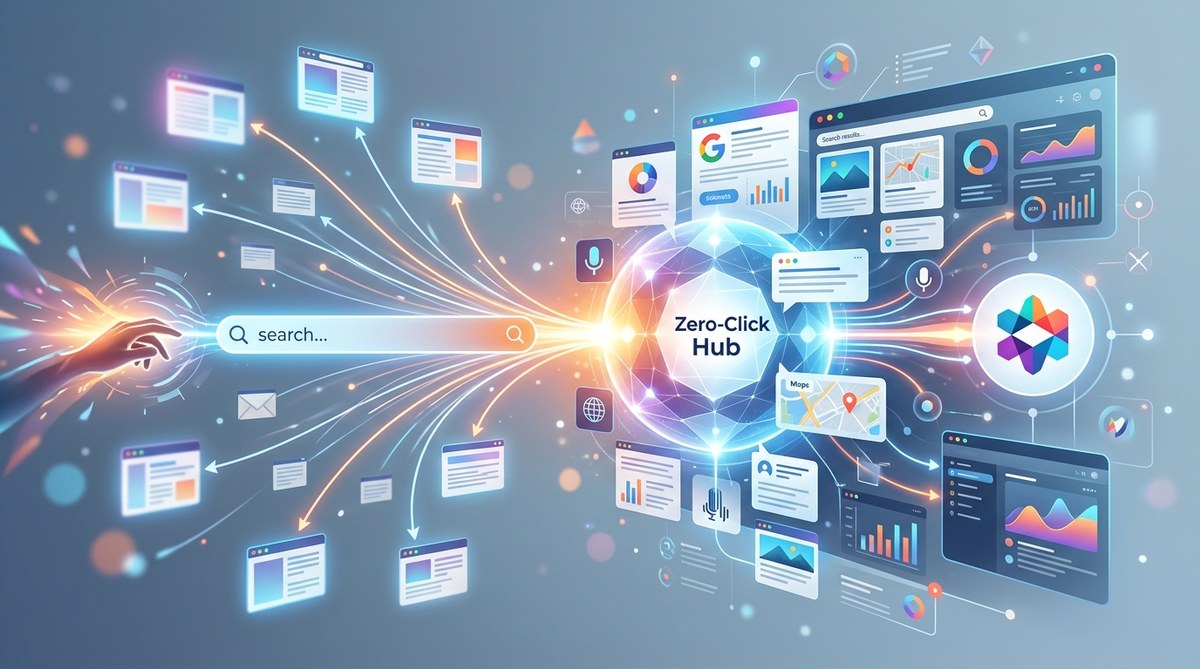
The search results page looks different than it did two years ago. Users get answers without leaving Google. Voice assistants read out the first result. Featured snippets shrink your click-through rate to almost nothing. This is the zero-click future, and it is not a prediction anymore. It is the reality your brand strategy must handle today. If your entire digital presence relies on driving traffic to a website, you are already losing ground. The brands that win in 2026 will be the ones that show up in the answer itself, not just in the link to the answer.
A zero-click future brand strategy shifts your focus from earning visits to earning authority. When users get answers directly from search results or voice assistants, your brand must own that space. This means restructuring content for snippets, building trust signals that work without a website visit, and measuring brand lift instead of just clicks.
Why your click-based strategy is already broken
Think about the last time you asked your phone a question. You did not scroll. You did not click. The assistant gave you an answer, and you moved on. That is the new user behavior. Google reports that over 65% of searches now end without a click to another website. For mobile searches, that number climbs even higher.
Your old strategy relied on a simple funnel. Write content, rank high, get the click, convert the visitor. That funnel has a hole in the middle now. The user gets the answer before they ever reach your site. If your brand strategy does not account for that, you are paying for content that serves the search engine but never reaches your audience.
The shift is not just about search engines either. Social platforms, AI chatbots, and smart speakers all pull information from the same sources. If your content is structured for a webpage, it fails in every other environment.
The three pillars of a zero-click brand strategy
To survive and thrive in this environment, you need to rebuild your approach around three core ideas. These are not optional tactics. They are the foundation of any modern brand strategy.
Authority over volume. Writing more pages does not help if none of them get selected as the featured result. You need to be the source that search engines trust. That means earning backlinks, publishing original research, and maintaining a consistent track record of accuracy.
Structured for extraction. Your content must be easy for algorithms to pull apart. This means using clear headings, concise definitions, and data that sits in a predictable format. If a search engine cannot find your answer in the first 40 words, it will pick someone else.
Brand recognition without a visit. Your brand name must appear in the answer itself. When a voice assistant reads out a snippet, it should say your brand name. When a user scans a featured result, they should see your logo. This requires optimizing for brand mentions and structured data that includes your identity.
How to audit your current strategy for zero-click readiness
Before you change anything, you need to know where you stand. Run through this checklist to see if your brand strategy is built for the zero-click future.
- Do your top 20 organic pages appear in any featured snippets? If not, your content structure is likely too vague or too long.
- Can a voice assistant answer a question using only your content? Test this by asking your smart speaker questions related to your industry.
- Does your brand name appear in the snippet text itself? If the answer comes from you but your brand is invisible, you have a branding problem.
- Are you measuring impressions and brand lift instead of just clicks? If your only metric is traffic, you cannot see the zero-click impact.
- Is your content formatted for structured data? Schema markup for FAQ, HowTo, and Product types is essential.
If you answered no to more than two of these, your strategy needs a serious update. Read our guide on building a resilient brand strategy in a rapidly changing digital landscape to start the foundation work.
A practical process to adapt your brand strategy
Here is a step by step process that any brand team can follow. It does not require a massive budget, just a shift in thinking.
-
Identify your core answerable questions. List the top 10 questions your customers ask. These are the queries that already drive search volume. For each question, write a single, definitive answer in 40 to 50 words. This becomes your snippet target.
-
Rewrite your most important pages for extraction. Take your highest traffic pages and restructure them. Put the direct answer in a clear paragraph at the top. Use an H2 heading that matches the question. Add a list or table for supplementary data.
-
Implement FAQ schema. Add structured data to every page that answers a question. This tells search engines exactly which text to pull for voice and snippet results. Without this, your content is just noise.
-
Build brand authority outside your site. Get mentioned in industry roundups, contribute to authoritative publications, and earn links from .edu and .gov domains. Search engines prioritize brands that are cited by other trusted sources.
-
Track brand lift metrics. Use branded search volume, direct traffic, and social mentions as your new KPIs. If your brand is getting more recognition but fewer clicks, you are winning.
For more on this, see our post on how to craft a future-proof brand strategy in 2026.
Common mistakes brands make in the zero-click world
Many brands try to adapt but make similar errors. Here is a table that breaks down the wrong approach versus the right one.
| The Mistake | Why It Fails | The Better Approach |
|---|---|---|
| Writing long, fluffy answers | Algorithms truncate anything past 50 words. | Lead with a short, direct answer. Add depth below. |
| Ignoring voice search completely | Over 40% of adults use voice search daily. | Write in a conversational tone that sounds natural when read aloud. |
| Hiding brand identity in the content | Users see the answer but not the source. | Include your brand name naturally in the snippet text. |
| Only measuring clicks | You miss the value of zero-click visibility. | Track impressions, brand searches, and direct visits. |
| Skipping structured data | Search engines cannot extract your content. | Add FAQ, HowTo, and Article schema to every page. |
Why voice search changes the game for brand strategy
Voice search is the most extreme version of the zero-click future. When someone asks Siri or Alexa a question, they get one answer. There is no list of results. There is no scrolling. There is just a single voice reading out a single source.
If your brand is not that source, you do not exist in that moment. And because voice assistants tend to stick with sources they trust, the first brand to claim a topic often holds it for a long time.
This means your brand strategy must prioritize being the default answer for your core topics. That requires a combination of technical SEO, content authority, and brand recognition. Our article on is your brand strategy keeping pace with the rise of voice and visual search goes deeper into this specific challenge.
The brands that treat zero-click as a threat will keep fighting for scraps. The brands that treat it as an opportunity will own the space where decisions are made. The choice is yours.
How to measure success when clicks are not the goal
This is the hardest mental shift for most marketing teams. You have been trained to optimize for click-through rate. But in a zero-click world, a high click-through rate can actually mean your snippet is not working well. A good snippet answers the question completely, which means the user does not need to click.
So what do you measure instead?
- Branded search volume. Are more people searching for your brand name after seeing your content in snippets?
- Direct traffic. Are users bypassing search and coming straight to your site?
- Snippet appearance rate. What percentage of your target queries show your brand in a featured snippet?
- Share of voice. How often does your brand appear in results compared to competitors?
- Assistant mentions. Ask a smart speaker a question. Does it mention your brand?
For a deeper look at metrics, check out our piece on 7 brand strategy metrics that matter most in 2026.
The content formats that win in a zero-click environment
Not all content is created equal when it comes to extraction. Some formats are naturally better suited for snippets and voice search.
- Lists and steps. Google loves pulling numbered lists for “how to” queries. If your content includes a clear step by step process, format it as a numbered list.
- Definitions. Short, authoritative definitions of terms are prime snippet material. Write a “what is” section at the top of every relevant page.
- Data points. Statistics and figures with clear attribution get pulled into answer boxes. Use a consistent format like “X percent of Y do Z.”
- Comparisons. Tables comparing products or services are highly likely to become featured snippets. Use a simple two column table with clear headers.
If you want to see how these formats work in practice, read 7 brand strategy tactics to dominate the age of algorithmic discovery.
Why brand trust is your most valuable asset here
In a zero-click world, the user never visits your site. They never see your design. They never read your about page. All they have is the answer itself. That means your brand trust must be built entirely through the accuracy and usefulness of that answer.
If your snippet is wrong, users will remember your brand as the one that gave a bad answer. If your snippet is helpful, they will associate your brand with reliability. There is no middle ground.
This is why first party data and original research are so valuable. When you publish a study that no one else has, search engines have no choice but to cite you. You become the definitive source. Our guide on why your brand strategy needs a first-party data revolution in 2026 explains how to build that advantage.
Your zero-click action plan for the next 90 days
You do not need to overhaul everything at once. Start with these three moves.
First, audit your top 10 pages for snippet readiness. If they do not have a clear, 40 word answer at the top, rewrite them. Second, add FAQ schema to your most important content. This is a technical fix that takes an hour but can double your snippet appearance rate. Third, start tracking brand lift metrics alongside your usual traffic numbers. Give yourself permission to celebrate a snippet appearance even if it does not generate a click.
Once those steps are in place, you can move on to more advanced work like voice optimization and structured data for products. The key is to start now. Every month you wait is a month your competitors spend claiming the snippet space you should own.
What comes after zero-click
The zero-click future is not the end of the road. It is a stepping stone to a world where search becomes entirely invisible. AI agents will book flights, order products, and answer questions without the user ever seeing a screen. Your brand strategy must be ready for that too.
When an AI agent chooses a product, it does so based on structured data, reviews, and brand authority. If your product information is not clean and complete, the agent will pick a competitor. If your brand is not cited as a trusted source, the agent will ignore you.
This is why the work you do today for zero-click search is also the work you need for the AI driven future. They are the same skills. Structured content, brand authority, and trust signals. Get those right now, and you will be ready for whatever comes next.
For a broader view of where things are heading, take a look at is your brand strategy ready for the age of AI.
Make the shift before your competitors do
The zero-click future is not something to fear. It is a chance to rethink how your brand shows up in the world. When you stop chasing clicks and start building authority, you create a brand that works across search, voice, social, and AI.
Start with one page. Rewrite it for snippets. Add schema. Measure the result. Then do it again. Over time, you will build a brand strategy that does not rely on a single visit to survive. It will thrive in every format, on every device, and in every moment a user needs an answer.
The brands that make this shift now will own the next decade. The brands that wait will keep fighting for a shrinking pool of clicks. Choose which one you want to be.